
Jazakallah Meaning: 50+ Replies, Uses & Examples

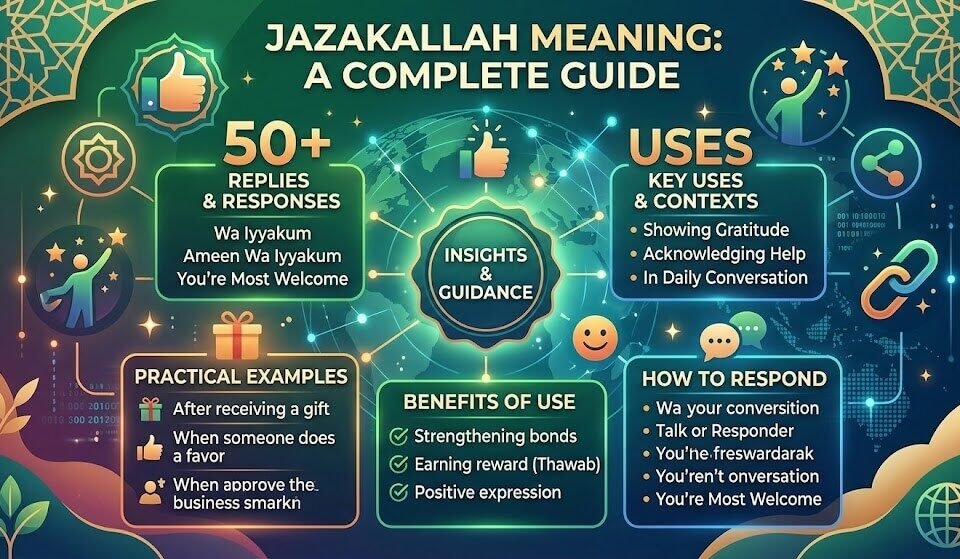
The phrase “Jazakallah” is a beautiful Islamic expression used to show gratitude, respect, and appreciation for someone’s kindness, help, or good actions. Unlike a simple “thank you,” Jazakallah carries a deeper meaning
because it is also a prayer asking Allah to reward the person for their efforts. Muslims around the world use this phrase in daily conversations to express sincere appreciation while wishing blessings and goodness for others.
In this guide, you will discover the complete meaning of Jazakallah, its pronunciation and transliteration, the difference between Jazakallah and Jazakallah Khair, how to use it correctly in different situations, and the appropriate ways to reply when someone says it.
Whether you are learning this Islamic phrase for the first time or want to understand its proper usage, this article will help you use Jazakallah with confidence and respect.
Jazakallah Pronunciation and Transliteration
Jazakallah (juh-zak-uh-lah)
The correct pronunciation and transliteration of Jazakallah help non-Arabic speakers understand and use this meaningful Islamic expression properly. The phrase is written in Arabic as جزاك الله and is commonly transliterated as Jazakallah, Jazak Allah, or Jazāk Allāh.
It is pronounced as “Juh-zak-uh-lah”, with the phrase divided into two parts: “Jazak” and “Allah.” While saying it, the words should be spoken clearly and respectfully, as the phrase carries a beautiful prayer of gratitude.
Because Arabic sounds cannot always be perfectly represented using English letters, different transliterations of Jazakallah are commonly used. Some people write it as Jazakallah, while others prefer Jazak Allah or Jazāk Allāh to show
the original Arabic pronunciation more closely. Another common variation is JazakAllahu Khairan (جزاك الله خيرًا), which means “May Allah reward you with goodness” and is often used as a more complete expression of thanks.
The pronunciation may slightly differ depending on a person’s language or accent, but the meaning and intention remain the same. Whether you use Jazakallah in daily conversations, after receiving help, or when appreciating someone’s kindness,
saying it with sincerity is what makes the phrase truly meaningful. Understanding its pronunciation and transliteration allows you to use this Islamic expression of gratitude with confidence and respect.
Allah, helping you understand this meaningful Islamic phrase more deeply.
Jazakallah Meaning for Male and Female
The phrase Jazakallah is a meaningful Islamic expression used to thank someone while making a beautiful prayer for them. It means “May Allah reward you” and is often said when someone does something kind, helpful, or beneficial. Although the meaning remains the same for both males and females, the Arabic wording can change slightly depending on the gender of the person being addressed.
When saying Jazakallah to a male, the commonly used form is “JazakAllahu Khairan” (جزاك الله خيرًا), which means “May Allah reward you with goodness.” The word “Jazak” is directed toward a male person in Arabic grammar. This phrase is often used when thanking a brother, father, friend, teacher, or any male who has helped or supported you.
When addressing a female, the phrase changes slightly to “Jazakillahu Khairan” (جزاكِ الله خيرًا). This is the feminine form in Arabic and carries the same meaning: “May Allah reward you with goodness.” It can be used when thanking a mother, sister, friend, teacher, or any woman for her kindness, support, or good actions.
Although these grammatical differences exist in Arabic, many Muslims commonly use “Jazakallah” as a general way of expressing gratitude in everyday conversations. The most important part of this phrase is the sincere intention behind it,a heartfelt prayer asking Allah to reward and bless the person for their kindness and efforts. Whether said to a male or female, Jazakallah reflects respect, appreciation, and thankfulness in a beautiful Islamic way.
How to Use Jazakallah in Daily Conversations
Jazakallah is a beautiful way to express gratitude while making a prayer for someone’s well-being. It can be used in everyday conversations whenever someone helps you, shows kindness, gives advice,
shares knowledge, or does something valuable for you. Instead of only saying “thank you,” using Jazakallah adds a spiritual meaning by asking Allah to reward that person for their good action.
You can use Jazakallah in many different situations, whether in personal conversations, online messages, or social interactions. For example, you can say it when someone helps you complete a task, gives you useful information,
supports you during a difficult time, or offers a kind gesture. Muslims often use this phrase with family members, friends, teachers, colleagues, and community members as a sincere expression of appreciation.
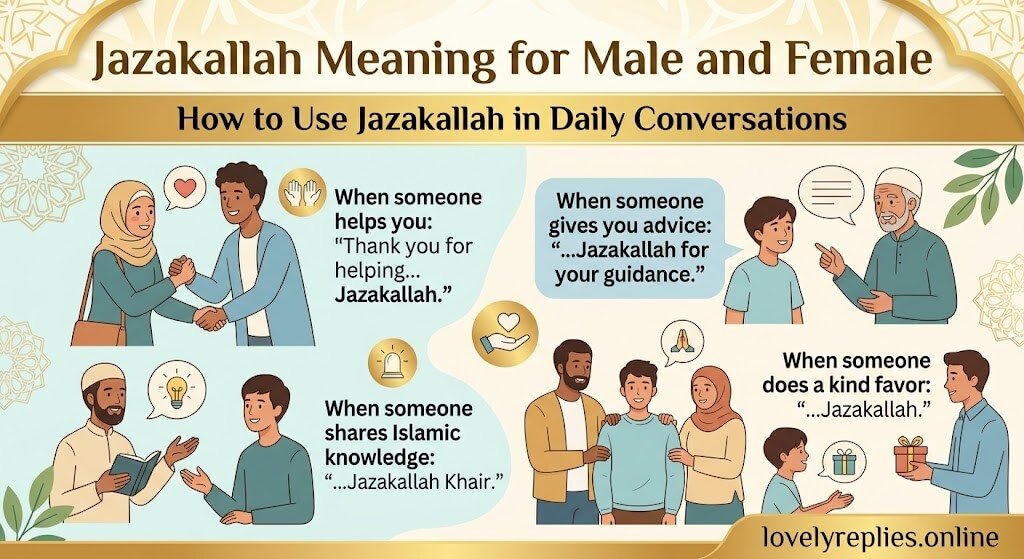
Examples of using Jazakallah in daily conversations:
- When someone helps you:
“Thank you for helping me with this. Jazakallah.” - When someone gives you advice:
“Your advice was very helpful. Jazakallah for your guidance.” - When someone shares Islamic knowledge:
“Thank you for sharing this reminder. Jazakallah Khair.” - When someone supports you:
“I truly appreciate your support during this time. Jazakallah for everything.” - When someone does a kind favor:
“May Allah reward you for your kindness. Jazakallah.”
When using Jazakallah, sincerity matters more than the situation itself. It is not only a phrase of thanks but also a way of showing respect and wishing blessings for another person. Whether spoken face-to-face, written in a message, or shared online, Jazakallah helps make expressions of gratitude more meaningful and heartfelt.
How to Reply to Jazakallah
When someone says Jazakallah to you, it is a way of expressing gratitude and making a prayer that Allah rewards you for your kindness or help. A common and appropriate response is to reply with another positive prayer or expression of appreciation. The reply does not need to be complicated; even a simple response with sincerity is considered meaningful.
The most common reply to Jazakallah is “Wa iyyak” (وإياك) for a male and “Wa iyyaki” (وإياكِ) for a female, which means “And you as well” or “May Allah reward you too.” Another commonly used response is “Wa iyyakum” (وإياكم) when speaking to more than one person or in a respectful plural form. These replies return the same good wishes and show mutual gratitude.
Here are some other ways to reply to Jazakallah:
- Wa iyyak — May Allah reward you too.
- Wa iyyaki — May Allah reward you too (when speaking to a female).
- Wa iyyakum — May Allah reward you all.
- Ameen, wa iyyak — Ameen, and may Allah reward you too.
- Jazakallah Khair as well — May Allah reward you with goodness too.
- BarakAllahu feek — May Allah bless you.
- Thank you, may Allah bless you too — A simple English response with the same meaning.
The best reply depends on the situation and your comfort with Arabic phrases. Whether you respond in Arabic or English, the main purpose is to acknowledge the kindness and return the prayer with sincerity. A heartfelt response keeps the spirit of gratitude and respect that Jazakallah represents.
Jazakallah vs Jazakallah Khair
Both Jazakallah and Jazakallah Khair are Islamic expressions used to show gratitude and appreciation, but there is a slight difference in their meaning and completeness. Both phrases are based on the Arabic word “Jaza”, which relates to reward or recompense, and they are used when thanking someone while making a prayer for Allah’s reward.
Jazakallah (جزاك الله) means “May Allah reward you.” It is a short form of expressing thanks and asking Allah to reward someone for their kindness, help, or good action. Although this phrase is commonly used in daily conversations, it does not specify the type of reward being requested.
Jazakallah Khair (جزاك الله خيرًا) means “May Allah reward you with goodness.” The addition of “Khair” (خيرًا), meaning “goodness” or “good,” makes the phrase more complete because it specifically asks Allah to grant the person a good and blessed reward. This longer form is often preferred because it carries a deeper meaning and expresses a more detailed prayer for someone.
In everyday use, many Muslims say Jazakallah as a simple expression of gratitude, while Jazakallah Khair or JazakAllahu Khairan is considered a more complete and traditional form. Both phrases carry the beautiful message of appreciation, respect, and wishing blessings for the person being thanked. The most important part is the sincerity behind the words and the intention to appreciate someone’s kindness.
Common Mistakes When Using Jazakallah
Jazakallah is a beautiful Islamic expression of gratitude, but sometimes people make small mistakes when using or writing this phrase. Understanding the correct meaning, pronunciation, and usage can help you express your appreciation in a more respectful and accurate way. While these mistakes are usually unintentional, learning the proper form allows you to use this meaningful phrase with confidence.
Here are some common mistakes people make when using Jazakallah:
- Using Jazakallah Without Understanding the Meaning
One common mistake is using Jazakallah simply as a replacement for “thank you” without knowing its meaning. Jazakallah is not only a phrase of gratitude; it is also a prayer asking Allah to reward someone. Understanding its meaning helps you use it with sincerity and respect. - Forgetting to Add “Khair” When Expressing a Complete Prayer
Many people say Jazakallah while the more complete phrase is JazakAllahu Khairan (جزاك الله خيرًا), meaning “May Allah reward you with goodness.” Adding “Khair” makes the prayer more specific and expresses a wish for a good reward from Allah. - Using the Wrong Gender Form in Arabic
Arabic has different forms depending on whether you are speaking to a male or female.
- JazakAllahu Khairan (جزاك الله خيرًا) — used when addressing a male.
- Jazakillahu Khairan (جزاكِ الله خيرًا) — used when addressing a female.
Although many people use the general form “Jazakallah” in everyday conversations, knowing the correct Arabic forms helps improve accuracy.
- Incorrect Pronunciation
Another mistake is pronouncing Jazakallah incorrectly because Arabic sounds can be difficult for non-native speakers. Pronouncing it clearly as “Juh-zak-uh-lah” helps maintain the correct meaning and shows respect for the phrase. - Confusing Jazakallah With a Regular Thank You Phrase
While Jazakallah is used to show appreciation, it has a deeper meaning than a simple “thank you.” It includes a prayer for Allah’s reward and blessings, making it a more spiritual expression of gratitude. - Using It Without Sincerity
Like any expression of gratitude, Jazakallah should come from the heart. Saying it without genuine appreciation can reduce its meaning. The intention behind the words is what makes the phrase special. - Not Knowing the Appropriate Reply
Some people do not know how to respond when someone says Jazakallah. Common replies include “Wa iyyak” (for a male), “Wa iyyaki” (for a female), or “Wa iyyakum” (for multiple people), meaning “And you too” or “May Allah reward you as well.”
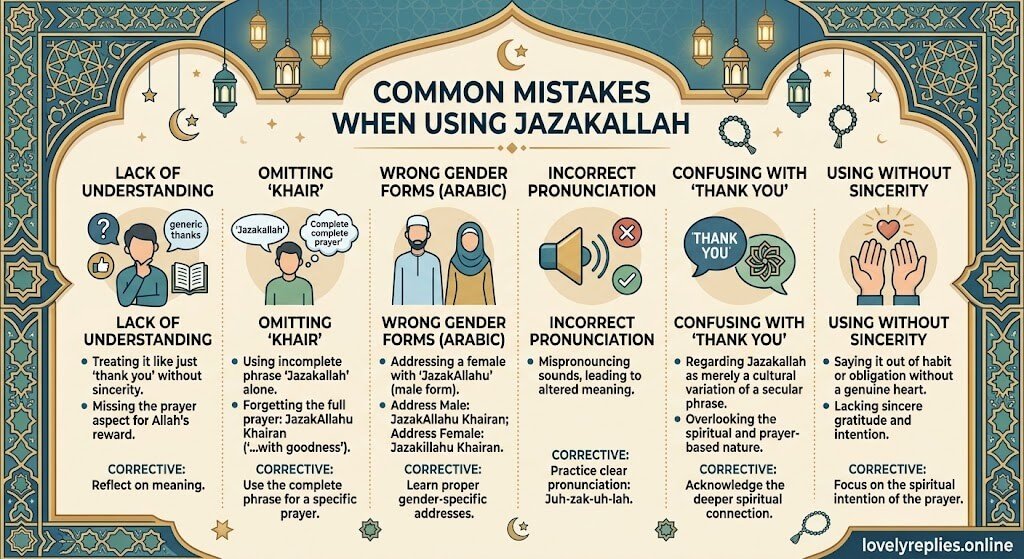
Using Jazakallah correctly is a simple way to show gratitude, respect, and kindness. By understanding its meaning and avoiding these common mistakes, you can use this beautiful Islamic phrase in a more meaningful way during everyday conversations.
Beautiful Jazakallah Messages and Examples
Jazakallah is a heartfelt way to express gratitude while making a beautiful prayer for someone. Whether someone has helped you, supported you, shared knowledge, or shown kindness, saying Jazakallah adds a deeper meaning to your appreciation. These messages can be used in daily conversations, text messages, social media posts, or personal notes to let someone know that their efforts are valued.
Here are some beautiful Jazakallah messages and examples you can use:
💛 Jazakallah Khair for your kindness and support. May Allah bless you with endless happiness and success.
🌸 Jazakallah for always being there when I needed help. May Allah reward you for your beautiful heart.
🙏 Jazakallah Khair for your guidance and encouragement. May Allah increase you in blessings and goodness.
✨ Your kindness means more than words can express. Jazakallah for everything you have done for me.
💙 Jazakallah Khair for your time, effort, and support. May Allah reward you with the best in this life and the Hereafter.
🌷 Thank you for your generosity and care. Jazakallah for making a positive difference in my life.
🤍 Jazakallah Khair for sharing your knowledge and reminding me of what is good. May Allah reward you abundantly.
🌟 May Allah bless you for every good thing you do. Jazakallah for your kindness and sincerity.
💫 Jazakallah Khair for your patience and understanding. Your support has truly meant a lot to me.
🌺 I deeply appreciate your help and compassion. Jazakallah for being such a wonderful person.
❤️ Jazakallah Khair for bringing positivity and happiness into my life. May Allah always keep you blessed.
🙌 Thank you for your sincere efforts and thoughtful actions. Jazakallah for everything.
🌈 Jazakallah Khair for your friendship and support. May Allah strengthen our bond and bless you always.
💖 Your kindness will never be forgotten. Jazakallah for the good you have done for me.
🌼 May Allah reward you for every smile you bring, every help you offer, and every kindness you show. Jazakallah Khair.
Short Jazakallah Messages
- 💛 Jazakallah Khair for everything.
- 🌸 May Allah reward you with goodness.
- 🙏 Jazakallah for your kindness and support.
- ✨ May Allah bless you always.
- 💙 Jazakallah Khair for being so helpful.
- 🌷 Your kindness is truly appreciated. Jazakallah.
- 🤍 May Allah increase you in blessings and happiness.
- 🌟 Thank you for everything. Jazakallah Khair.
Jazakallah Messages for Someone Who Helped You
- 🙏 Jazakallah Khair for helping me when I needed it most. May Allah reward you for your generosity.
- 💛 I truly appreciate your help and support. Jazakallah for making things easier for me.
- 🌸 May Allah bless you for your kindness and the effort you put into helping others. Jazakallah Khair.
Jazakallah Messages for Teachers and Mentors
- 📚 Jazakallah Khair for sharing your knowledge and guiding me on the right path. May Allah reward you greatly.
- ✨ Your teachings and advice have made a meaningful impact on my life. Jazakallah for your efforts.
- 🌟 May Allah bless you for the knowledge you share and the lives you inspire. Jazakallah Khair.
Using Jazakallah in your messages is a meaningful way to combine gratitude with a prayer for blessings. Whether you are thanking a friend, family member, teacher, or anyone who has helped you, these words can make your appreciation feel more sincere and special.
Frequently Asked Questions About Jazakallah
What does Jazakallah mean?
Jazakallah means “May Allah reward you.” It is an Islamic expression used to show gratitude while making a prayer that Allah rewards someone for their kindness, help, support, or good actions.
What is the meaning of Jazakallah Khair?
Jazakallah Khair means “May Allah reward you with goodness.” The word “Khair” means goodness, making this phrase a more complete way of asking Allah to grant someone a good and blessed reward.
Is Jazakallah the same as thank you?
Jazakallah is similar to saying “thank you,” but it has a deeper spiritual meaning. Instead of only expressing appreciation, it includes a prayer asking Allah to reward the person for their kindness.
When should I say Jazakallah?
You can say Jazakallah whenever someone helps you, supports you, gives you advice, shares knowledge, or does something kind for you. It can be used in daily conversations, messages, and social interactions.
What is the correct reply to Jazakallah?
A common reply to Jazakallah is “Wa iyyak” (وإياك), which means “And you too” or “May Allah reward you as well.” Other replies include “Wa iyyaki” for a female and “Wa iyyakum” for a group of people.
Can females say Jazakallah?
Yes, females can also use Jazakallah. In Arabic, the form may change depending on who is being addressed. For example, Jazakillahu Khairan is used when speaking to a female, while JazakAllahu Khairan is used when speaking to a male.
Is it better to say Jazakallah or Jazakallah Khair?
Both expressions are commonly used and understood. However, Jazakallah Khair or JazakAllahu Khairan is considered a more complete phrase because it specifically asks Allah to reward someone with goodness.
How do you pronounce Jazakallah?
Jazakallah is commonly pronounced as “Juh-zak-uh-lah.” The exact Arabic pronunciation may vary slightly, but the main meaning remains the same.
Can I write Jazakallah in English letters?
Yes, Jazakallah can be written in English letters as a transliteration. Common spellings include Jazakallah, Jazak Allah, JazakAllah, and JazakAllahu Khairan.
Is Jazakallah only used by Muslims?
Jazakallah is primarily used by Muslims because it includes a prayer to Allah. It is commonly used within Muslim communities as an expression of gratitude and respect.
Can I say Jazakallah to a non-Muslim person?
The phrase is a religious expression and is generally used when speaking within an Islamic context. Some Muslims may choose to use it with non-Muslims as a personal expression of gratitude, while others may use a simple “thank you” instead.
What is the difference between Jazakallah and Shukran?
Shukran simply means “thank you” in Arabic, while Jazakallah includes a prayer asking Allah to reward the person. Both express gratitude but carry different meanings.
Can Jazakallah be used in text messages?
Yes, Jazakallah is commonly used in text messages, WhatsApp conversations, emails, and social media posts. Many people use it to express appreciation in a respectful and meaningful way.
What should I reply when someone says Jazakallah Khair?
You can reply with:
- Wa iyyak And you too.
- Wa iyyaki And you too (to a female).
- Ameen, wa iyyak Ameen, and may Allah reward you too.
- BarakAllahu feek May Allah bless you.
Does Jazakallah have a religious meaning?
Yes, Jazakallah has a religious meaning because it asks Allah to reward someone. It combines gratitude with a prayer for blessings and goodness.
Can I say Jazakallah for small favors?
Yes, you can say Jazakallah for both small and big acts of kindness. Whether someone helps with a simple task or provides major support, the phrase is a respectful way to show appreciation.
Why do Muslims say Jazakallah instead of thank you?
Many Muslims use Jazakallah because it expresses gratitude while also making a dua (prayer) for the person. It reflects the belief that Allah is the ultimate source of reward and blessings.
Is Jazakallah mentioned in the Quran?
The exact phrase “Jazakallah” is not a direct Quranic verse, but the concept of rewarding good deeds and showing gratitude is strongly emphasized in Islamic teachings.
What is the best way to use Jazakallah?
The best way to use Jazakallah is with sincerity and understanding. Say it when you genuinely appreciate someone’s effort, kindness, or support, and remember that it is both a thank-you and a prayer for blessings.
Conclusion
Jazakallah is a beautiful way to express gratitude while making a sincere prayer for someone. It means “May Allah reward you” and can be used when someone helps, supports, guides, or shows kindness to you. Understanding its pronunciation, meaning, gender forms, and common replies can help you use this Islamic expression correctly.
Whether you say Jazakallah or the more complete JazakAllahu Khairan, the most important thing is sincerity and appreciation. With the right understanding, you can use Jazakallah confidently in daily conversations, text messages, and meaningful moments of gratitude.
Read more:
150+ I Appreciate You Messages to Show You Care
150+ God Bless You Wishes, Messages & Prayers